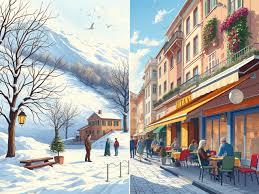
Relocating to Europe can feel like stepping into a beautifully framed movie: cobbled streets, charming cafés, quiet parks, efficient trains, and a fascinating mix of languages. But once the first rush of excitement fades, everyday life starts to reveal quirks you might never have anticipated. Some are delightful, some mildly irritating, and others require genuine inner adjustment. Attitudes toward leisure, nightlife, and entertainment can be unexpectedly relaxed, and you may notice how casually friends suggest a game night or even trying live casino online crazy time without anybody finding it unusual.
These culture shocks are rarely dramatic. More often, they are small, repeated frictions that slowly reshape how you plan your week, how you talk to people, and even how you think about work, the state, and your own identity. Understanding them in advance won’t remove the surprises, but it can make them easier to interpret and less likely to feel like personal failures or misunderstandings. For newcomers relocating to Europe who plan to bring their vehicle from the UK, using a dependable Car Shipping Company Kent can simplify the transition by handling cross-border vehicle transport efficiently and compliantly.
The Pace of Life: Fast Cities, Slow Sundays
One of the first contradictions newcomers notice is tempo. Major European cities move quickly: trains depart on time, people walk with purpose, and meetings start at the scheduled hour. Yet weekends, especially Sundays, can feel almost frozen in comparison, as if someone quietly turned down the volume of public life.
In many countries, shops close early or do not open at all on Sundays and public holidays. For anyone used to round-the-clock convenience, this feels like an unnecessary inconvenience at first. Groceries need to be planned, errands must be done earlier, and you learn to accept that certain tasks simply cannot be completed at certain times. The hidden logic is a cultural preference for protected downtime, for a predictable moment in the week when commercial noise pauses and life narrows down to family, friends, or solitary rest.
Bureaucracy: Orderly, Yet Overwhelming
Europe is frequently associated with order and rules, and newcomers quickly discover that this reputation has a basis in reality. Registering your address, obtaining a residence permit, or signing up for public services can involve thick stacks of forms, appointments at specific offices, and a baffling list of required documents.
The culture shock comes from how heavily the system leans on written procedures rather than improvisation. Officials may appear rigid, but they are often just following a clearly defined protocol. Once you understand that the “game” is to play by those rules—arrive with the correct papers, keep copies of everything, follow instructions precisely—the experience becomes more predictable. It is frustrating, but it also reflects a deeper belief in impersonal fairness and formal structure.
Privacy, Politeness, and the “Cold” First Impression
Another recurring surprise is the way many Europeans handle personal boundaries. In some cultures, warmth is expressed through enthusiastic small talk and quick openness. In many parts of Europe, however, politeness can mean giving others space rather than jumping into conversation. A neighbor who gives a brief nod but does not stop to chat is not necessarily unfriendly; they may feel that respecting your privacy is the polite thing to do.
Politeness also takes different forms: using formal titles, greeting everyone in a room, or waiting patiently in queues without cutting ahead. To an outsider, this can look distant or stiff, but it carries its own quiet courtesy. The challenge for newcomers is to avoid interpreting reserved behavior through the lens of their home culture. What looks “cold” may actually signal respect, caution, or simply a slower path toward intimacy.
Direct Communication Styles
In professional and academic settings, many Europeans value direct speech. Feedback that might be carefully softened elsewhere is delivered more bluntly: a report may be called “not good” or “unconvincing” without much verbal padding. In international teams, this can produce a sharp shock. Those used to more indirect or euphemistic styles may feel personally attacked, while local colleagues believe they are simply being honest.
The underlying assumption is analytical: ideas are being evaluated, not people. Once you recognize this distinction, seemingly harsh comments become easier to interpret. Direct communication reduces ambiguity; expectations tend to be clearer, and disagreements are more openly discussed. Adapting to this style requires thicker skin, but it also offers the benefit of knowing where you stand.
Money, Social Benefits, and Expectations of the State
For many newcomers, pay slips and public services generate another wave of culture shock. Taxes and social contributions in Europe can look high at first glance, especially compared with countries where the state plays a smaller role in daily life. But these contributions are tied to expectations: the state is meant to provide solid health care, affordable education, social protections, and a safety net for the vulnerable.
The real adjustment is not just financial; it is philosophical. You may find yourself rethinking what counts as a fair exchange between individual and society. Public debates about social spending, pensions, and welfare are intense because they touch core values. Understanding this broader context helps explain both the dense regulations and the emotional investment citizens often have in policy decisions.
Everyday Diversity: Languages, Identities, and Micro-Cultures
Another subtle shock lies in how fragmented and diverse Europe feels once you move around. Cross a border and you may encounter a different language, new food habits, and distinct social rules within a couple of hours. Even within a single country, regions can feel like separate micro-cultures, with their own dialects, traditions, and stereotypes.
For a newcomer, this is both exhilarating and demanding. You are constantly recalibrating your behavior: how to greet, how loudly to speak in public, how formal to be, when tipping is expected. Rather than a single “European culture,” you discover a dense mosaic of local habits. Over time, this trains you to observe more carefully and to avoid assuming that what worked in one place will automatically work everywhere else.
Work–Life Balance and the Meaning of “Success”
Many people move to Europe expecting an intense, always-on career path and are surprised to find a different set of priorities. Long hours at the office are not automatically admired, and taking all your vacation days is considered normal rather than a sign of weak ambition. Parents may notice relatively strong support structures around childcare and family life, though the details vary from country to country.
This can trigger an internal conflict. You might feel uneasy leaving work “early” by the standards you grew up with, even when colleagues are already heading home. Gradually, you realize that your sense of duty and productivity is not universal but culturally shaped. Adjusting does not mean abandoning ambition; it means learning to pursue it within a framework that grants legitimacy to rest, leisure, and a life outside the office.
Learning to Be a Long-Term Newcomer
Perhaps the most understated culture shock is discovering that adaptation never completely ends. Even after several years, new layers of nuance keep appearing: jokes you finally understand, historical references that suddenly click, political debates you can follow without getting lost. You may never feel entirely “local,” yet you no longer fit neatly into your previous identity either.
Moving to Europe is not just about crossing a border; it is an ongoing exercise in observation and self-reflection. The culture shocks do not vanish, but they soften and become more intelligible. With time, the habits that once puzzled or annoyed you often turn into features you appreciate—and the process of grappling with them quietly reshapes how you see both your new home and the world you came from.